Salt Air and Your AC: Why Some Treasure Coast Systems Quit at Nine and Others Reach Fifteen
Two houses on one street can own the same system, and one still quits years earlier than the other.
October 13, 2026 · 4 min read
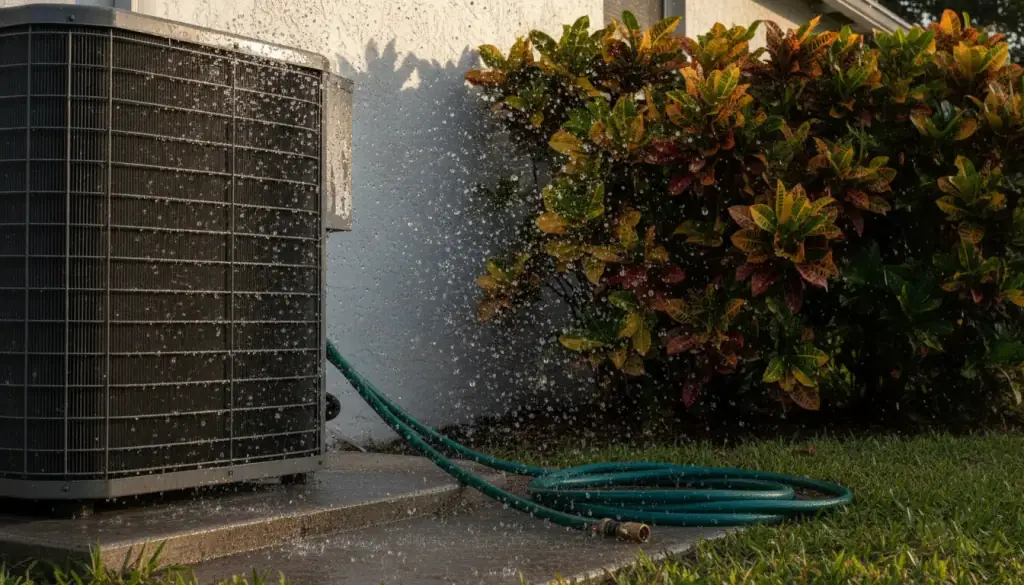
Two houses on the same street can have the same air conditioner, installed the same year. One quits at nine. The other is still cooling at fifteen. We've worked on systems from Stuart to Vero Beach since 1988, and the difference usually isn't luck. It's what happened to the outdoor coil, the drain line and the electrical parts, one season at a time.
What salt air actually does
The outdoor unit, called the condenser, is a coil of thin metal tubes and fins with a big fan pulling air through it. Coastal air carries salt, and salt on bare metal does what it does to a car parked near the beach. It eats at the fins and then at the tubing. Fins crumble. Tiny pinhole leaks can open in the tubes, and a coil with a pinhole slowly loses refrigerant until the system can't cool the house anymore.
You don't have to live on the oceanfront for this to matter. Wind carries salt inland, and the air along the rivers and the Intracoastal does its share too. The closer you are to the water, the faster it happens, but almost everyone on the Treasure Coast is close enough to care.
Dirt and salt together are worse
A condenser coil also collects pollen, lawn clippings, dust and storm debris. When that film sits on the fins, it holds moisture and salt against the metal and keeps it damp. It also blocks airflow, so the system runs longer and hotter to do the same job. A compressor that runs hot all summer is a compressor that wears out early.
Rinsing the coil the right way, with the right pressure, takes that film off before it does damage. This is the biggest reason a tune-up isn't a formality in our part of Florida. Your system works most of the year here, so it has a lot of chances to get dirty and a lot of hours to pay for it.
More than the coil
Salt and humidity don't stop at the coil. Electrical connections loosen and corrode. The drain line that carries moisture away from your indoor unit grows slime and clogs. Capacitors and contactors, the small parts that start your compressor and fan, get tired from heat and from all the starts a long cooling season asks of them. None of that shows up until something fails on the hottest day of the week.
What a good maintenance visit covers
A real tune-up is a list of things done and checked, not a quick look and a handshake. Ours is a 21-point inspection, and it includes:
- Rinsing the outdoor coil so salt and debris come off before they eat the fins
- Clearing and treating the condensate drain line so it doesn't back up into the house
- Tightening electrical connections, which work loose and corrode over time
- Checking the amp draw on the compressor and fan motors, which catches a part that's starting to fail
- Verifying refrigerant so a slow leak gets found early instead of in August
- Swapping the filter
The point of the amp readings and the electrical check is to find the weak part while it's still working. A capacitor that's close to failing costs far less to replace on a scheduled visit than on a Saturday night with the house at 84 degrees.
What you can do between visits
- Keep shrubs, fences and stored items a couple of feet back from the unit so air can move freely
- Sweep leaves and clippings off the pad, and point sprinkler heads away from the cabinet
- Change the indoor filter on schedule, because a clogged filter makes the whole system work harder
- After a big storm, look the unit over for debris. Shut off the power at the disconnect before you pull anything out of it
- Skip the pressure washer. It bends the fins and can push water where it shouldn't go
Why we recommend two visits a year
Our Maintenance Club is two visits a year: one before cooling season and one after. The first gets you ready for the months of heavy runtime. The second catches what the summer did before it sits over the cooler months. Members also get priority scheduling in a heat wave and a discount on parts, and keeping up with maintenance helps keep your manufacturer's warranty valid.
The plain truth is that a system cleaned, checked and tightened twice a year has a real shot at reaching fifteen years in salt air. A system nobody touches tends to quit a lot sooner.
Where to start if it's been a while
If nobody has looked at your system recently, new customers can get our $69 A/C tune-up. If you need a repair after the inspection, the diagnostic fee comes off the bill. Call us at (772) 284-5774 and a real person will pick up, any hour.
Super Cool of the Treasure Coast, Inc., (772) 284-5774
Call (772) 284-5774More articles
Water Around Your Air Handler: Why the Drain Line Clogs Every Summer and What to Do
A puddle by the air handler is the most common cooling problem on the Treasure Coast, and it's usually fixable fast.
Repair or Replace? How to Decide When Your AC Is Twelve to Fifteen Years Old
Every repair feels reasonable by itself, which is how people end up paying for a system they should have retired.